Electronic Arts Canada's 1994 classic — its history, how the press received it, how it plays today, and what a copy costs.

- Released
- 1994 · PC (DOS / Windows)
- Developer
- Electronic Arts Canada
- Publisher
- Electronic Arts
- MobyScore
- ★ 8.01
- Players today
- 3 user reviews on Steam (100% of 3)
The history
FIFA International Soccer was developed by Electronic Arts Canada and served as the debut entry for the best-selling series licensed by football's world governing body. It arrived at a time when the market was dominated by titles like Kick Off and Sensible Soccer, carving out its own space through a distinct approach to presentation and perspective.
The title mattered because it introduced a dimetric (isometric) viewpoint that was unusual for football games at the time, a stylistic choice that was quickly imitated by other titles. It also pioneered a televisual presentation, featuring hosts who introduced matches, which helped the game stand out from its contemporaries.
How it plays
The gameplay loop focuses on direct control of international teams featuring fictional player names, with each athlete rated out of 10 in various skill areas. Players engage in matches where the strategy privileges short passes, quick runs, and powerful shots from outside the penalty box. Set pieces are handled by moving a target box into the desired area before passing, lobbing, or kicking the ball.
Tactically, players can select different formations and choose from five different strategies, as well as define team coverage for defenders, midfielders, and strikers. Standard options allow for the toggling of offsides and fouls, as well as adjustments to match length and timer behavior.
How it was received
The game received mostly positive feedback upon release. In the UK, it sold 400,000 copies in the final two weeks of December 1993, becoming the fifth best-selling home video game of the year in that country and the best-selling video game of the year in Europe overall, surpassing EA's initial 300,000 unit projection. In the US, it topped the Super NES sales chart in June 1994.
Critics praised its simulation qualities; Computer Gaming World called it a "remarkably complete simulation of the sport" with pinpoint passing accuracy. Mean Machines Sega awarded it 94%, calling it the "greatest soccer game yet seen," while the 3DO version earned a maximum five-star score from Next Generation as a "killer-app graphics showhorse." Then-current critics hailed it as revolutionary, a sentiment that persists today with a 100% positive rating from the few users reviewing it on Steam.
In the magazines
The period press.
Mean Machines Sega gave the game 94%, praising its "superlative presentation," while Joypad awarded it 95%, calling it an essential title. MAN!AC gave it 88 out of 100, and Hobby Consolas recalled awarding it 93 out of 100. Next Generation gave the SNES version four stars out of five.
What players say today
Modern sentiment on Steam is positive, with 3 out of 3 user reviews rating the experience favorably.
“I thought this was a below-average line compared to others in the game. It's just not too memorable. The last few stations were okay, but it was just too little, too late by then. Nothing is 'wrong' w…”
Screenshots


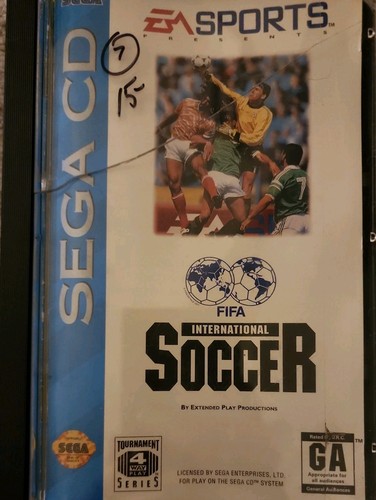
The box & the art
Cover art, and real copies photographed in the wild.
Legacy
The studio's lineage continued through EA Vancouver and EA Romania, who developed the franchise from 1993 until 2022. This original title is worth seeking out today as the progenitor of one of gaming's most successful licensed franchises, offering a glimpse into the shift toward simulation-style sports games.
What it's worth
Copies surface on the second-hand market from time to time, but listings are sparse enough that there's no reliable price band to quote — check the live search for what's available right now.
See current copies on eBay →How to play it in 2026
Easiest today: Steam or GOG (DRM-free) on modern Windows. Either way the core game is intact.
Verdict
FIFA International Soccer holds up as a fascinating historical artifact. While its slower pace—noted by Edge as a result of the isometric view—might feel sluggish compared to modern titles, its commitment to a "televisual" experience was ahead of its time.
It remains a rewarding experience for those who appreciate the charm of early 90s sports simulations and the specific tactical challenges of its era.
Sources: MobyGames, Steam, and period/web coverage. Prices reflect the second-hand market and change over time.