Activision's 1997 classic — its history, how the press received it, how it plays today, and what a copy costs.

- Released
- 1997 · PC (DOS / Windows)
- Developer
- Activision
- Publisher
- Activision
- MobyScore
- ★ 7.99
The history
Released in 1997, Zork: Grand Inquisitor is the third graphical entry in the Zork series. Developed and published internally by Activision, Inc., the title benefited from a shorter production cycle by utilizing the same engine as its predecessor, Zork Nemesis.
The game mattered as a tonal shift for the franchise, moving away from the direction of Nemesis to return to the humorous roots of the early Zork adventures. It serves as the final installment of the famous Zork adventure series.
How it plays
Players take on the role of the Ageless, Faceless, Gender-Neutral, Culturally-Ambiguous Adventure Person (AFGNCAAP), partnering with Dungeon Master Dalboz to overthrow the totalitarian regime of Grand Inquisitor Yannick. To restore magic to the land, the player must travel to locations like Hades and Flood Control Dam #3 to collect the Coconut of Quendor, the Skull of Yoruk, and a Cube of Foundation.
The gameplay is a first-person point-and-select adventure featuring pre-rendered backgrounds and live actors. The loop is heavily puzzle-oriented, focusing on inventory management and the use of magical spell scrolls. Players can cast spells to manipulate the environment—such as opening doors or making purple objects invisible—and can even cast spells backwards to achieve the opposite effect.
How it was received
The game received a mixed to positive reception, with GameRankings describing the reviews as "average." High marks came from PCZone (88%), PCGUS (88%), and Edge (8/10), while others were more reserved, such as CVG (3/5). GameSpot praised it as a "model of adventure gaming" with polished FMV and absurdist humor, and Next Generation viewed it as a "step up" that put the series back on the right track. However, Matt Barton of Gamasutra noted that the game did not sell as many copies as Activision had hoped.
The title earned several accolades, including a runner-up spot for Computer Gaming World's 1997 "Adventure Game of the Year" and nominations from the Computer Game Developers Conference for "Best Adventure/RPG" and "Most Innovative Game Design."
In the magazines
The period press.
PCZone and PCGUS both awarded the game 88%, while PCGUK gave it 84%. Edge provided an 8/10, and Next Generation praised it as a return to form after the "serious stumble" of Nemesis.
Screenshots


The box & the art
Cover art, and real copies photographed in the wild.


Legacy
While two sequels were announced in August 1997 to complete a new trilogy, they did not materialize. The game's enduring quality was highlighted in 2011 when Adventure Gamers ranked it as the 12th-best adventure game ever released.
It remains worth seeking out today as a clever, well-written adventure that Destructoid describes as one of the most rewarding experiences for a Zork fan.
What it's worth
A second-hand market that moves over time — a loose disc is pocket-money, while sealed or complete-with-manual copies drive the top end. For today's exact listings, check the live search.
See current copies on eBay →Copies in the wild
Real listing photos — the range of condition you'll meet.


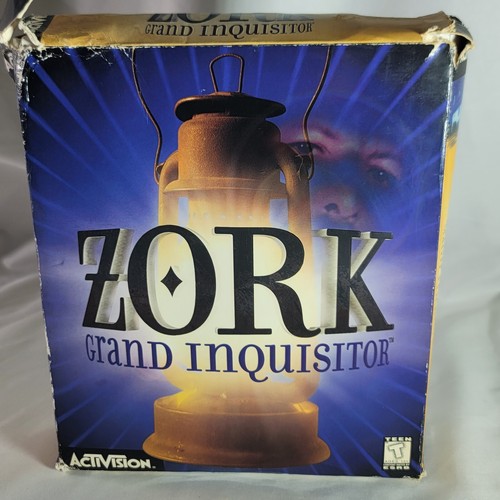


Photographed examples from past listings — illustrative of condition, not a live inventory.
How to play it in 2026
Easiest today: Steam or GOG (DRM-free) on modern Windows. Either way the core game is intact.
Modern versions on GOG and Steam have included updates to the build to match the DVD version and the enablement of ScummVM 2.0 support and Cloud Saves, though switching to ScummVM renders previous saves incompatible.
Verdict
Zork: Grand Inquisitor holds up as a polished example of the FMV era, balancing absurdist humor with fair, inventory-based puzzles. Its self-mocking tone and crisp delivery by live actors prevent it from feeling like a tedious exercise in item hunting.
While it may not be a "perfect Zork" to purists, its ability to blend the series' legacy with a refined adventure interface makes it a distinguished and entertaining relic of 1997.
Sources: MobyGames, Steam, and period/web coverage. Prices reflect the second-hand market and change over time.