ORIGIN Systems' 1992 classic — its history, how the press received it, how it plays today, and what a copy costs.

- Released
- 1992 · PC (DOS / Windows)
- Developer
- ORIGIN Systems
- Publisher
- ORIGIN Systems
- MobyScore
- ★ 8.27
- Players today
- 9 user reviews on Steam (67% of 9)
The history
Released in April 1992 for MS-DOS, Ultima VII: The Black Gate served as the seventh installment in the legendary role-playing series. Developed and published by Origin Systems, Inc.—the Austin, Texas-based studio founded by Richard Garriott, his brother Robert, and their father Owen—the game arrived during a pivotal year for the company, which was purchased by Electronic Arts in 1992.
The title mattered because it pushed the technological envelope of its era. Computer Gaming World noted its innovative object-oriented approach to the game map and new AI routines for party movement, while critics like Charles Ardai argued the game was daring and unusual, avoiding the feeling of being "more of the same" after six previous installments.
How it plays
Players return as the Avatar, arriving in Britannia to find that two hundred years have passed since their last visit. The loop involves exploring a vast world populated by NPCs with their own schedules, solving a ritualistic murder in the city of Trinsic, and uncovering the true purpose of a recruitment organization known as the Fellowship, all while pursued by the warnings of a mysterious being called the Guardian.
The game shifted the series toward a real-time system where the player controls the Avatar while party members fight automatically, though combat pauses when accessing the inventory. It introduced a mouse-controlled interface allowing players to physically drag, stack, and manipulate objects in the world or within containers. A "paper doll" equipment screen graphically displays equipped items, and the Avatar and their companions must regularly eat to survive.
How it was received
Upon release, the game received strong marks, with Allgame, Dragon, and White Wolf awarding it 4/5, 4/5, and 4.5/5 respectively, and GamePro giving its SNES version a 3.5/5. Computer Gaming World's Scorpia praised the "first-class" graphics and engrossing story, though she noted the combat was one of the least fun aspects and the slow performance added roughly a week to her playtime. Charles Ardai hailed the plot as the best in the series, describing it as an original allegory for real-world problems.
The game's enduring quality is reflected in later rankings; PC Gamer listed it as one of "The 50 Best Games Ever" in 1997 and ranked it 10th in a 2011 survey of the 100 Best PC Games of All Time. While period critics lauded its sophistication, modern Steam sentiment is more divided, with only 6 out of 9 user reviews being positive.
In the magazines
The period press.
Dragon gave the game 4 out of 5 stars in issue #191. White Wolf #33 rated it 4.5 out of 5, calling it a "must experience" event for fantasy gamers. GamePro described the SNES version as "nicely crafted fun" but criticized the respawning of monsters and chests.
What players say today
Modern players on Steam express a mix of views, with some finding the experience "really fun and derpy." However, there is specific frustration regarding DLC content, with users warning against the "Ultimate Weapon Pack" because the most powerful weapons are designed as a joke and sap the player's health, with one player describing the most powerful weapon as a "coffee bar."
“[h1]Now for some facts.[/h1] Each character gets 3 new weapons. The stats are always the same except for Vert's, Ram's and Rom's versions. Those differ slightly because of their skillset. [table] [t…”
“Good but... DON'T USE THE MOST POWERFUL WEAPON FOR EACH CHARACTER! These weapons are designed as a joke and actually sap your health!”
“Really fun and derpy for murdering the early parts of this game without even doing much, 3rd weapons are always useless over the others due to hp drain but other than that, really worth it and allows …”
Screenshots


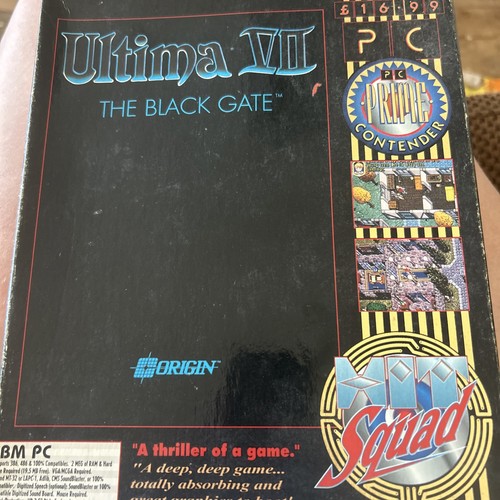
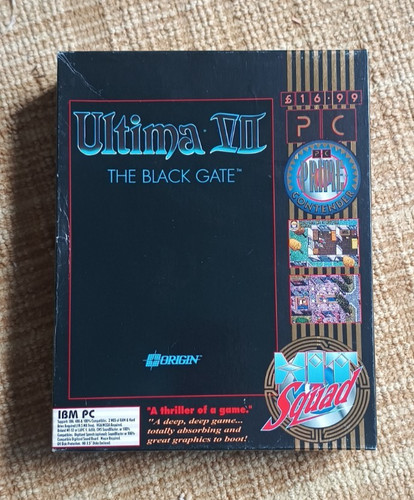
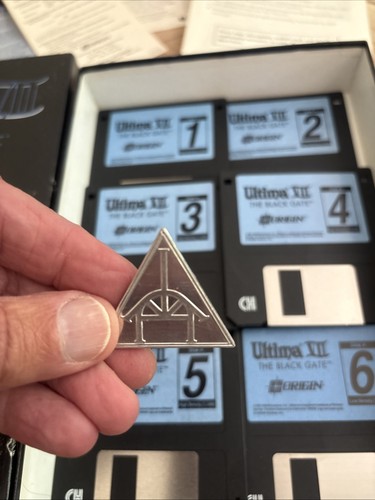
The box & the art
Cover art, and real copies photographed in the wild.
Legacy
Origin Systems went on to be best known for the Ultima and Wing Commander series. Ultima VII remains a landmark title, cited as a major influence by modern developers such as Todd Howard of Bethesda and Swen Vincke of Larian Studios.
What it's worth
A second-hand market that moves over time — a loose disc is pocket-money, while sealed or complete-with-manual copies drive the top end. For today's exact listings, check the live search.
See current copies on eBay →Copies in the wild
Real listing photos — the range of condition you'll meet.


Photographed examples from past listings — illustrative of condition, not a live inventory.
How to play it in 2026
Easiest today: Steam or GOG (DRM-free) on modern Windows. Either way the core game is intact.
Verdict
Despite some dated elements—such as the combat that even contemporary critics found lacking and the slow performance noted by Scorpia—the game's commitment to a complete, living fantasy world remains impressive. Its sophisticated interface and object-oriented world design were ahead of their time.
For those who can overlook the technical hurdles, it is a rewarding experience. As PC Gamer US noted in 1998, if you are seeking the best of the greatest computer role-playing series ever, this is the game you want.
Sources: MobyGames, Steam, and period/web coverage. Prices reflect the second-hand market and change over time.