Impressions Games' 1998 classic — its history, how the press received it, how it plays today, and what a copy costs.

- Released
- 1998 · PC (DOS / Windows)
- Developer
- Impressions Games
- Publisher
- Sierra On-Line
- MobyScore
- ★ 7.99
The history
Released in 1998 and developed by Impressions Games, Caesar III arrived as a sophisticated evolution of the city-building genre. Tasked with managing a small province, players had to balance the needs of their citizens and the whims of the Gods to prove their strength of mind and spirit in hopes of being crowned Caesar.
The title mattered because it shifted the focus toward complex systems and people. Rather than simple radius-based effectiveness, the game relied on the actual movement of citizens to make the city function, a design philosophy that distinguished it from other simulations of the era.
How it plays
The core loop involves placing buildings and laying out zones to create a prosperous and peaceful province. Success depends on managing intricate supply chains: buyers walk to the granary for food, while saleswomen deliver that food to houses, allowing them to evolve into higher-tier housing that provides more taxes. Every building requires hiring people directly from the streets to operate.
Beyond urban planning, players must manage trade and form armies for city defense. The simulation is highly reactive, requiring attention to the Gods to avoid disasters and the strategic adoption of new technologies as the city grows. Even basic services are simulated through individual agents; for example, a police officer must physically see a crime or fire to respond to it.
How it was received
Caesar III was a commercial and critical success, shipping 150,000 copies in its first month and ultimately selling around 2.5 million copies worldwide. It was a hit in the US, claiming ninth place for the month of October 1998, and earned a "Gold" award from the VUD for selling at least 100,000 units in Germany, Austria, and Switzerland by September 1999. Critics praised it as a well-rounded experience, with Tim Carter of Computer Gaming World calling it a "magnificent accomplishment" and Trent Ward of IGN describing it as an "expertly designed" strategy game.
While the economic and political models were lauded for their subtlety and addiction, the military aspects were a point of contention. Ron Dulin of GameSpot noted that combat was the game's weakest point, describing it as mostly a matter of selecting a group and clicking a point on the map.
In the magazines
The period press.
The game earned high marks across the board: PC Zone gave it 92/100, PC PowerPlay scored it 88%, and PCGUK gave it 87%. Other strong ratings included Hyper at 87%, IGN at 8.7, CVG at 4/5, rev2Score at 4/5, and rev3Score at 4/5. Computer Gaming World awarded it 4.5/5.
Screenshots


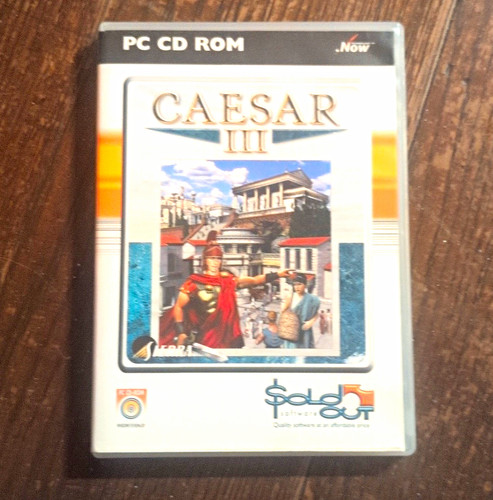
The box & the art
Cover art, and real copies photographed in the wild.


Legacy
Impressions Games later refined the Caesar III engine to create other acclaimed titles, including Pharaoh (1999) and Master of Olympus: Zeus (2000). The game remains worth seeking out today for its deep, agent-based simulation of urban life and its challenging economic puzzles.
What it's worth
Copies surface on the second-hand market from time to time, but listings are sparse enough that there's no reliable price band to quote — check the live search for what's available right now.
See current copies on eBay →Copies in the wild
Real listing photos — the range of condition you'll meet.

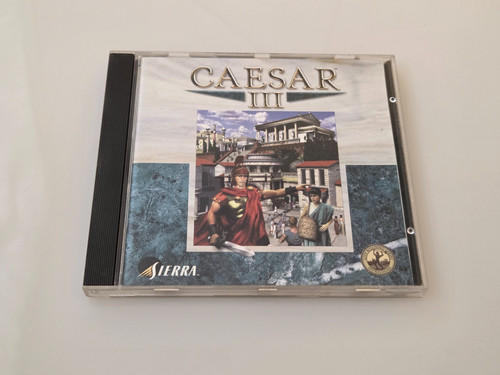
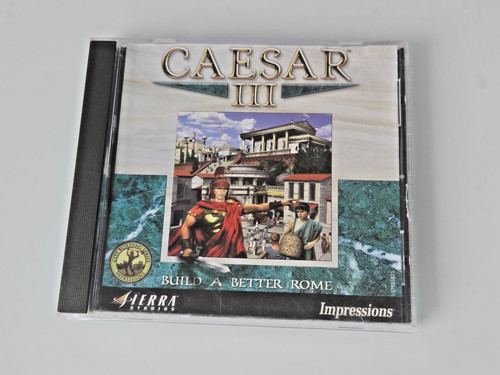
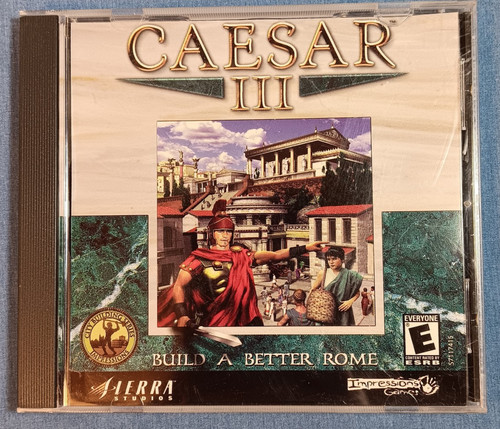
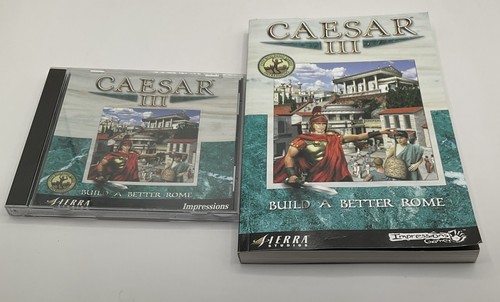

Photographed examples from past listings — illustrative of condition, not a live inventory.
How to play it in 2026
Easiest today: Steam or GOG (DRM-free) on modern Windows. Either way the core game is intact.
Modern versions on Steam and GOG have integrated DDrawCompat for stability on Windows 10 and 11 and an IndirectSound emulator to fix looping sound and music issues. While the original lacked native widescreen support, the community-driven Julius open-source re-implementation provides 32-bit windowed mode and widescreen support while maintaining 100% save compatibility.
Verdict
Caesar III holds up remarkably well for those who enjoy "systems" gaming. The way the city breathes—with individual citizens walking the streets to provide services and trade—creates a level of organic complexity that many modern city builders lack.
While the combat is simplistic and lacks the depth of the economic simulation, the core loop of evolving housing and managing supply chains remains satisfyingly addictive.
Sources: MobyGames, Steam, and period/web coverage. Prices reflect the second-hand market and change over time.